
- 🕒 Mon - Sat 9AM - 6PM
- 📞 Phone : +91 98186 44599

By Dr. Ram Prakash, Maaeri Fertility & IVF Centre
Polycystic ovary syndrome is the commonest hormonal disorder in women of reproductive age, and one of the commonest reasons ovulation stops being reliable. The place to start, though, is with the thing patients are least often told plainly: most women with PCOS do conceive. Many with targeted lifestyle or medical support, some with assisted reproduction. What that path looks like differs from woman to woman, and it starts with an accurate picture of what the condition is doing in your particular case rather than in general.
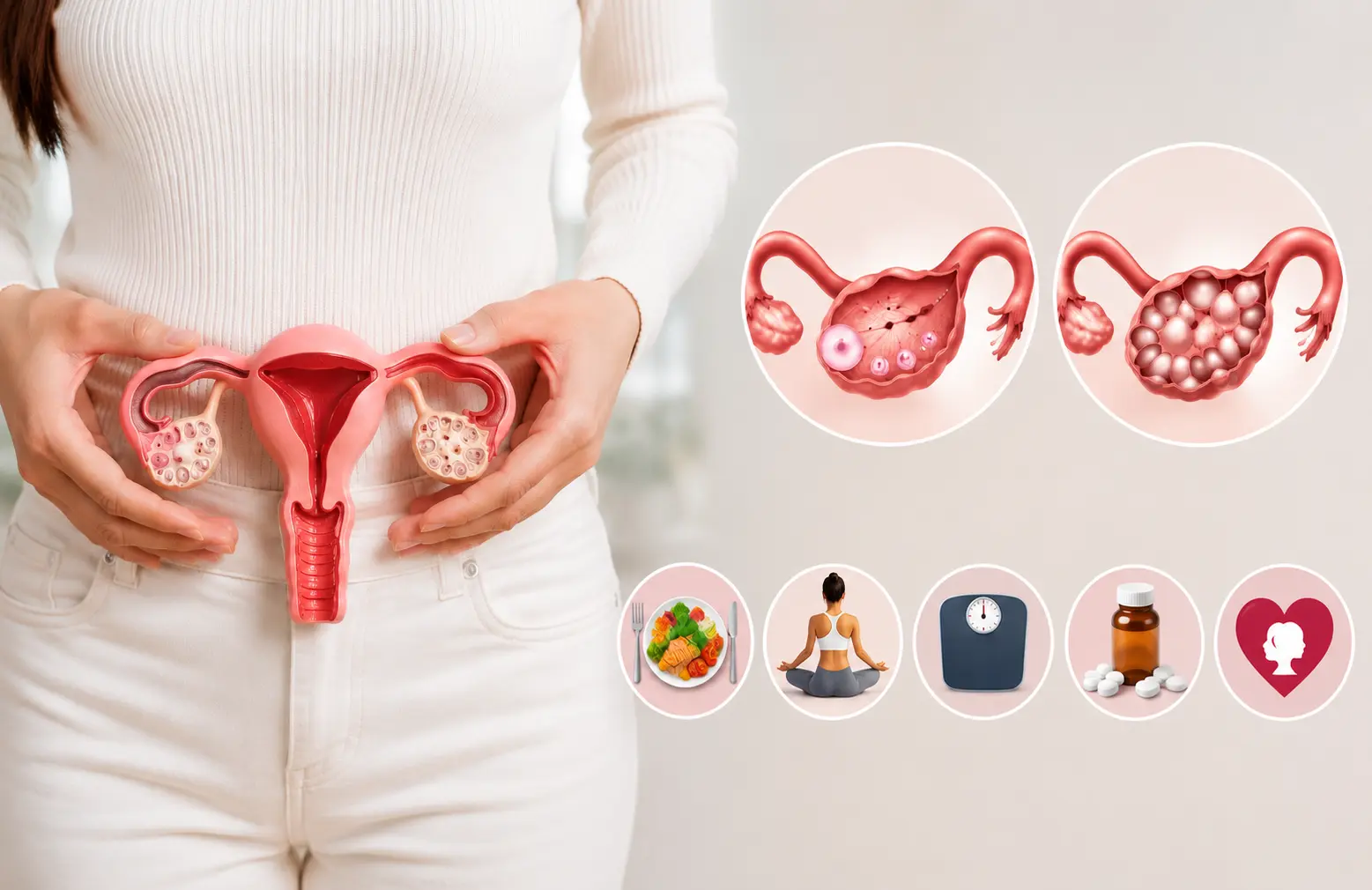
PCOS interferes with the hormonal signalling that drives ovulation. Raised androgens and insulin resistance, both hallmarks of it, disturb the normal process by which one follicle gets selected, and what happens instead is that multiple small follicles develop and none of them matures. Ovulation becomes irregular or stops. Fertile windows become irregular or stop with it. Conception cannot be reliable when the ovulation underneath it is not. Knowing where you are in your menstrual cycle is the first practical step, and in PCOS that is genuinely difficult to know without tracking tools.
For a woman with PCOS who is overweight, weight loss has more evidence behind it than any other first step. A 5-10% reduction in body weight restores ovulation in a significant proportion of women, with no medication involved at all. It works mainly by improving insulin sensitivity, which brings the androgens down and lets the hormonal balance needed for follicle development re-establish itself.
Women who are not overweight are not excluded from this. Regular moderate exercise and a low-glycaemic diet improve insulin sensitivity in them too and can regularise cycles. What patients need to hear is that it is slow. Two to three months before any hormonal improvement can be measured. The reason it is worth doing anyway is that everything tried afterwards works better from that baseline.
When lifestyle alone has not been enough, ovulation induction is next, and the options below are a ladder rather than a menu. We start at the top and move down only when we have to:
Ovulation induction with timed intercourse that has not produced a pregnancy after three to six cycles is the point at which the conversation changes, and so is the discovery of another factor altogether, a tubal problem or male factor infertility. At Maaeri we ask for full fertility testing on both partners before committing to further induction cycles, and the reason is practical rather than procedural. Treating ovulation on its own while something else is also wrong costs months and puts a couple through a great deal for nothing.
IVF in PCOS runs on a modified protocol. Lower starting doses, a GnRH antagonist to stop premature ovulation, and usually freeze-all. All of it is aimed at the same thing, which is keeping OHSS risk down without giving up success rates, and it is why the transfer usually happens in a later thawed cycle instead of straight after the retrieval.
Can women with PCOS conceive naturally?
Yes, and many do. Ovulating irregularly is still ovulating. The difficulty is timing, and tracking with OPKs or cycle monitoring improves the odds considerably without any medical treatment at all.
Does PCOS mean IVF is inevitable?
No. Most women with PCOS who come for treatment conceive on lifestyle changes or oral ovulation induction and never need it.
Does PCOS affect pregnancy once conception occurs?
There is a modestly raised risk of gestational diabetes and of preterm birth, which is why antenatal monitoring is a little more attentive in patients with PCOS.
For most women this is achievable. What it takes is working out which part of the process actually needs support and matching the intervention to that gap rather than to the diagnosis. The PCOS pathway at Maaeri is built to begin with the simplest step that fits, on the assumption that most patients will not need the most intensive treatment on the shelf.
This article is for general educational purposes and is not a substitute for personalised medical advice from your fertility specialist or embryologist


