
- 🕒 Mon - Sat 9AM - 6PM
- 📞 Phone : +91 98186 44599

By Dr. Ram Prakash, Maaeri Fertility & IVF Centre
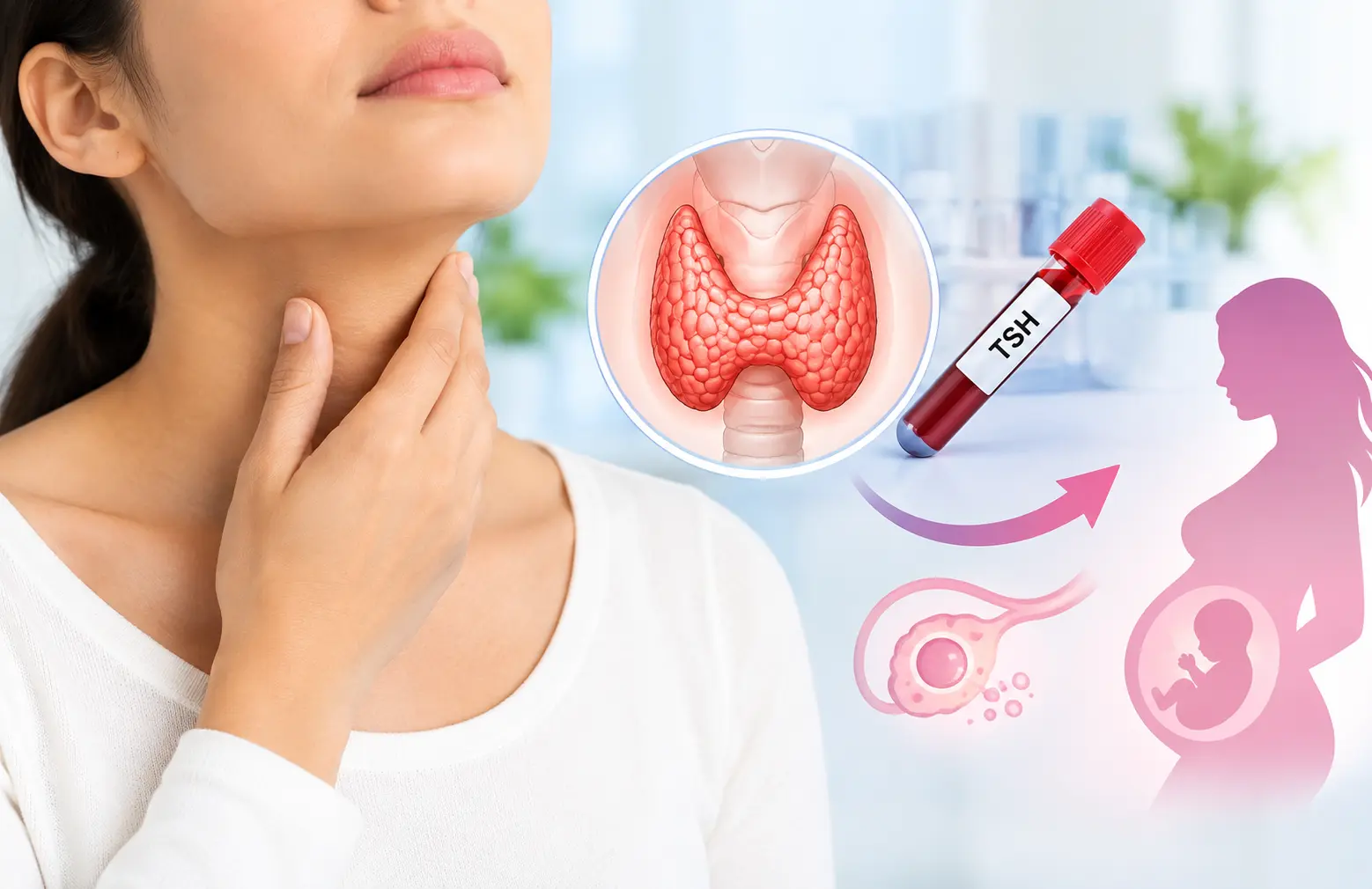
Do you know how closely your thyroid and your fertility are actually connected? Most couples do not realise it until they are already struggling to conceive. The thyroid gland does not directly produce any reproductive hormones itself, however its output, working through TSH regulation and through the whole cascade of metabolic effects which thyroid hormones control, reaches right into your ovulation, your implantation and your early pregnancy development. That is what makes it one of the very first things which is worth checking in any fertility workup.
TSH, which stands for thyroid-stimulating hormone and which is produced by your pituitary gland, is what controls the thyroid hormone output. When the system is working correctly, the TSH stays within its reference range and the output remains steady. However, when the thyroid underperforms, whether overtly or subclinically, the TSH rises as the pituitary tries to compensate for it, and that has significant downstream effects on your reproductive function.
Thyroid hormone receptors are present in the ovary, in the endometrium and in the early placenta. Thyroid hormones directly influence follicle development, oocyte maturation, and endometrial preparation for implantation. So when the thyroid function is impaired, these processes are being disrupted at a cellular level and not merely at a hormonal one.
Hypothyroidism disrupts your ovulation through two separate mechanisms. The first is that a thyroid hormone deficiency alters the GnRH secretion coming from your hypothalamus, which disrupts the FSH and LH release. The second is that elevated TRH is able to raise your prolactin, and prolactin directly suppresses ovulation. The result of all this is irregular cycles, anovulation, or luteal phase insufficiency, and every one of those reduces your window for conception.
Moreover, for the women who do conceive while their hypothyroidism is untreated, early pregnancy loss and impaired placental development are significantly more common than they are in women whose thyroid function is normal. This is partly the reason why thyroid screening is now considered standard in the pre-conception evaluation at Maaeri.
Subclinical hypothyroidism, which is a mildly elevated TSH alongside normal T3 and T4, is the most common thyroid abnormality in women who are trying to conceive and it is also the one which is missed most easily. A great many women feel entirely well with it. The reproductive impact is more modest than overt hypothyroidism, however it is measurable, and it matters particularly in the first trimester when an adequate thyroid hormone supply is critical for the fetal neurological development.
The question of whether treating subclinical hypothyroidism with levothyroxine actually improves pregnancy rates remains actively debated. What is not in debate at all is that identifying it early, monitoring it, and treating the confirmed overt cases significantly reduces your risk.
Yes it does, although less commonly. An overactive thyroid accelerates your metabolism and it can disrupt the hormonal balance which ovulation needs, but it does so in a different way, working through elevated oestrogen metabolism, altered SHBG levels and direct ovarian effects. Irregular or absent periods are seen with hyperthyroidism as well. Uncontrolled hyperthyroidism during a pregnancy carries significant risks with it, and those include premature birth, low birth weight and fetal thyroid dysfunction, which is what makes identifying and treating it before conception so important.
A comprehensive thyroid panel for fertility includes the following:
This full panel is a part of the fertility assessment which we carry out for all of our new patients, and the reason is that antibody positivity in the presence of a normal TSH still warrants monitoring during your fertility treatment and your early pregnancy.
What TSH level is considered optimal for trying to conceive?
The guidelines do vary on this. Most endocrinologists advise aiming for a TSH which is below 2.5 mIU/L while you are actively trying to conceive, although that target has been debated in the recent research. What matters more than any fixed cutoff is reviewing the full panel with your doctor and adjusting the treatment if the picture as a whole is suggesting impaired thyroid function.
Can thyroid medication affect fertility treatment?
Levothyroxine, which is the standard treatment for hypothyroidism, is safe during both fertility treatment and pregnancy, and replacing your thyroid hormone up to a normal level is beneficial rather than being risky.
If my TSH is normal, can I rule out thyroid problems affecting fertility?
Not entirely, no. Antibody positivity, meaning Hashimoto's, is able to exist alongside a normal TSH and still be clinically relevant to your fertility and your early pregnancy. A TSH on its own without any antibody testing gives you an incomplete picture.
Thyroid and fertility are connected in enough clinically meaningful ways that a full thyroid panel is worth completing early in any fertility investigation. It is one of the most straightforward and most treatable factors there is to identify, and addressing it genuinely improves outcomes at Maaeri and elsewhere.
This article is for general educational purposes and is not a substitute for personalised medical advice from your fertility specialist or embryologist


