
- 🕒 Mon - Sat 9AM - 6PM
- 📞 Phone : +91 98186 44599

By Dr. Ram Prakash, Maaeri Fertility & IVF Centre
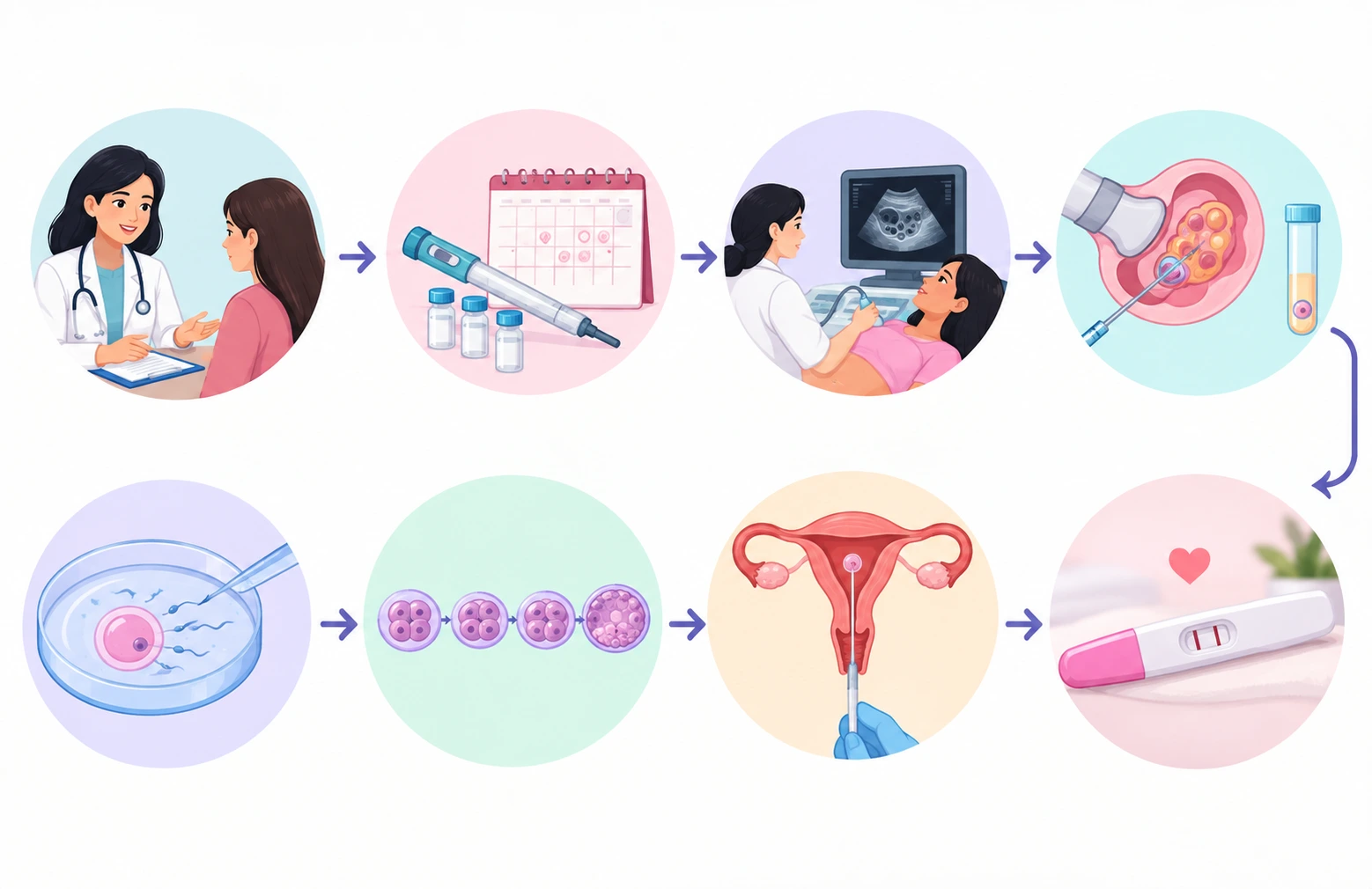
Do you know why it is so hard to get a straight answer about how long IVF takes? It is usually one of the very first practical questions which patients ask us, and the honest answer involves several different timelines all running in parallel with one another. There is the stimulation cycle, then the laboratory phase, then the transfer cycle, and then the two-week wait, and each one of them has its own rhythm. Understanding the full IVF cycle timeline before you start is what helps with the practical planning, and moreover it reduces the anxiety which comes from not knowing which phase is coming next.
Before any medication is started at all, a baseline assessment is needed. That means a transvaginal ultrasound to check for ovarian cysts or for any other cycle-start concerns, along with blood tests which confirm that your hormone levels are within the expected range for starting stimulation. This typically takes one single clinic visit, and it is usually scheduled at the start of a menstrual cycle.
Sometimes a short course of oral contraceptive pills is used in order to synchronise your cycle and allow some scheduling flexibility, and this adds one to three weeks before the stimulation begins, although it is not always required.
Ovarian stimulation runs for approximately 10 to 14 days, and during that period daily injectable hormone medications, which are the gonadotropins, stimulate your ovaries into developing multiple follicles. The monitoring appointments, meaning transvaginal ultrasound along with blood tests, occur every 2 to 3 days so that the follicle growth can be tracked and the doses adjusted. The thing to note is that this is typically the most time-intensive phase in terms of clinic visits.
Once the follicles reach 17 to 20 mm, a trigger injection is what initiates their final maturation. Egg retrieval then takes place 36 hours after that, and it is a minor day-procedure under sedation which lasts 15 to 20 minutes.
Over the five to six days which follow your retrieval:
A fresh transfer occurs on day 3 or day 5 after the retrieval, which means that going from stimulation to transfer takes approximately 17 to 21 days from the start of your injections.
A great many patients go through a freeze-all strategy, where every embryo is vitrified and the transfer is deferred. At Maaeri, freeze-all is standard for the high OHSS risk patients, and that includes PCOS, as well as for cycles which involve PGT testing, or for cases where the lining response was poor. A frozen embryo transfer cycle, or FET cycle, typically starts in the following menstrual cycle.
A programmed FET cycle runs for 3 to 4 weeks, which is two weeks of oestrogen and then 5 to 6 days of progesterone before the embryo transfer happens, so it adds 4 to 6 weeks between your retrieval and your transfer.
After the transfer, a pregnancy test is taken 14 to 16 days later. The two-week wait is very often the most difficult part of the whole process emotionally. However, the symptoms during this phase are unreliable indicators of what the outcome is going to be.
|
Phase |
Approximate Duration |
|
Pre-cycle preparation |
1 to 4 weeks (if OCP used) |
|
Stimulation |
10 to 14 days |
|
Egg retrieval |
Day 14 of stimulation |
|
Laboratory / embryo development |
5 to 6 days |
|
Fresh transfer (if applicable) |
Day 19 to 22 from cycle start |
|
FET cycle (if freeze-all) |
Additional 4 to 6 weeks |
|
Two-week wait |
14 to 16 days |
|
Total (fresh cycle) |
5 to 7 weeks |
|
Total (freeze-all cycle) |
10 to 14 weeks |
Does IVF disrupt work significantly?
Roughly four to six monitoring visits across the two-week stimulation phase are the main scheduling consideration for you. Most patients manage those around their work. Retrieval and transfer days do require time off, however the recovery is same-day.
Can I continue working during IVF?
Yes, and most people do. The cycle involves early-morning clinic visits but it does not involve extended leave. Retrieval requires sedation, so one to two days off is sensible there. The transfer itself has no recovery requirement at all.
What if my cycle is cancelled?
Cycles are sometimes cancelled because of insufficient or excessive ovarian response. Repeating it with an adjusted protocol is standard practice. How long IVF takes after a cancellation depends on the protocol change, but typically it is one natural cycle, meaning four to six weeks.
Understanding the full IVF cycle timeline right from your first consultation is what helps with the practical planning, meaning the leave, the logistics and the expectations. Our team at Maaeri covers all of this in detail at every pre-treatment appointment.
This article is for general educational purposes and is not a substitute for personalised medical advice from your fertility specialist or embryologist


