
- 🕒 Mon - Sat 9AM - 6PM
- 📞 Phone : +91 98186 44599

By Dr. Ram Prakash, Maaeri Fertility & IVF Centre
Patients often come to us after an ultrasound report that says "bulky uterus". The first question is nearly always the same. What does it mean for my chances of getting pregnant? The term is a descriptive finding. It is not a diagnosis on its own. But in most women of reproductive age a bulky uterus points to adenomyosis. And adenomyosis does change the fertility and pregnancy picture.
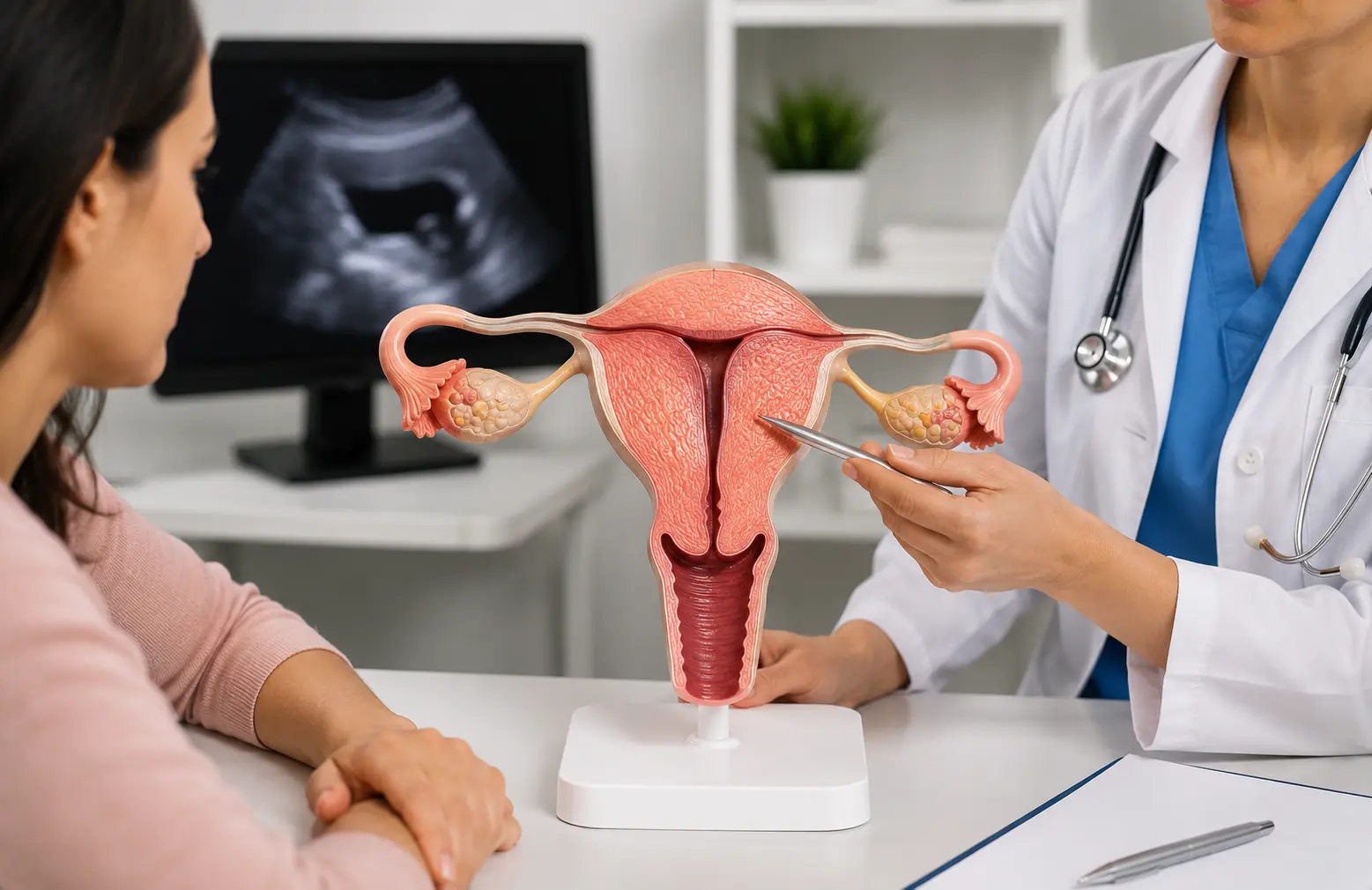
A bulky uterus just means the uterus is larger than normal. In reproductive-age women the usual cause is adenomyosis. This is where endometrial tissue embeds into the muscular wall of the uterus. The wall thickens. The uterus grows. Adenomyosis is not the same as fibroids. Both can enlarge the uterus, yes. But fibroids are discrete growths. Adenomyosis is a diffuse infiltration of the muscle wall itself.
Research keeps returning to two mechanisms.
Studies comparing IVF patients with and without adenomyosis report consistent gaps:A gap of this size comes up at the planning stage. The sequence of steps before transfer usually matters more than the drug protocol itself.
|
Outcome |
With Adenomyosis |
Without Adenomyosis |
|
Implantation rate |
around 31.9% |
roughly 46.7% |
|
Live birth rate |
near 31.4% |
54.8% |
|
Miscarriage rate |
about 31% |
14.1% |
It depends on the case. GnRH-analogue hormone suppression is the usual first step. It quiets disease activity before stimulation begins. Conservative adenomyomectomy is considered in a narrower group. It has shown benefit in women aged 39 and under with failed IVF cycles behind them.
Pregnancy rates up to 60.8% have been reported in some series. The same benefit has not been shown for older patients. It has not been shown for women who are yet to attempt IVF. Surgery leaves a small risk of uterine rupture in a later pregnancy.
That risk is part of the consent discussion. A bulky uterus does not rule out IVF. It does not make surgery automatic. At Maaeri the finding is treated as a sequencing question. The order of treatment steps is set around it from the first visit.
Can I get pregnant naturally with a bulky uterus?
Yes. Adenomyosis lowers the chance of natural conception without removing it. Many women with the condition conceive on their own. Miscarriage risk runs higher. A full fertility assessment usually shows where the specific problem sits.
Is a bulky uterus always caused by adenomyosis?
Not always. Fibroids can enlarge the uterus. Multiple previous pregnancies can as well. The scan finding on its own is a description of size. Further investigation is needed to confirm the cause.
Will my bulky uterus get worse over time?
Adenomyosis is oestrogen-dependent. The condition usually stays active through the reproductive years. Some progression is possible. Improvement after menopause is common.


