
- 🕒 Mon - Sat 9AM - 6PM
- 📞 Phone : +91 98186 44599

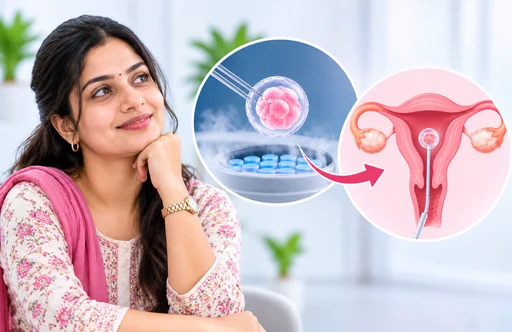
The frozen embryo transfer success rate has improved so much over the last ten years that FET is now the preferred transfer approach in most IVF cycles, not a fallback. Understanding what the success rates really mean, how the cycle is prepared, and why many clinics, Maaeri included, now suggest freezing all embryos instead of transferring fresh, helps make sense of advice that can feel back to front at first.
A frozen embryo transfer (FET) means thawing an embryo that was vitrified earlier and placing it in the uterus, in a different cycle from the one when the eggs were collected. The embryo, usually a blastocyst, is warmed with a carefully controlled method and checked to make sure it survived before transfer. In well-equipped labs, the large majority of vitrified embryos survive warming.
FET is used when a fresh cycle left spare embryos, after a freeze-all approach (where nothing is transferred fresh), or when a donor egg cycle produced several embryos for later. Read more about our frozen embryo transfer service.
The frozen embryo transfer success rate depends mainly on how old you were when the eggs were collected, not how old you are at transfer. Frozen embryos don't age in storage, so the biological clock effectively stops when they're frozen.
SART data shows FET live birth rates now match or beat fresh transfer rates in most age groups, especially in women under 38. Studies comparing the two have also linked FET with lower risks of preterm birth and low birthweight.
The main job before transfer is preparing the endometrium, getting the lining to the right thickness and receptivity.
In a natural FET, your own ovulation provides the hormones. Scans start around Day 10 to confirm a follicle is growing and catch the LH surge. A blastocyst is transferred about five days after the surge. No added oestrogen or progesterone is needed, although progesterone support is often added after the surge. This suits women with regular cycles.
In a medicated cycle, oestrogen (by mouth, patch or vaginally) starts on Day 2 or 3 to build the lining. Once the lining reaches at least 7 mm with a triple-line pattern on the scan, progesterone is added to line the uterus up with the embryo's stage. A Day 5 blastocyst goes in five days after progesterone starts. This suits women with irregular cycles or PCOS, or anyone who wants a predictable transfer date.
The move towards freeze-all and FET comes from evidence on several fronts:
Uterine receptivity, because the high oestrogen of stimulation changes how genes in the lining behave in ways that may make implantation harder, and FET keeps the uterus away from that
Baby outcomes, since FET has been linked with lower risks of preterm birth, low birthweight and being small for gestational age compared with fresh transfer
OHSS prevention, because freezing everything means pregnancy hormones can't make OHSS worse in a fresh cycle
PGT compatibility, since genetic testing needs a blastocyst biopsy and time for results, and FET gives that time between retrieval and transfer
At Maaeri, for high responders and patients having PGT, we vitrify all suitable blastocysts and plan a medicated FET after at least one full cycle, so the uterus is in the best possible state for transfer. Our blog on fresh vs frozen embryo transfers covers the comparison in more depth.
Most clinics suggest waiting at least one full period (4 to 6 weeks) after retrieval so the ovaries and uterus can recover. There's no upper limit, since frozen embryos can be stored and used years later.
The transfer itself is usually painless, a bit like a cervical smear. Some women get mild cramping during it. No sedation or anaesthetic is needed.
It can come down to the embryo, the lining or both. If a good blastocyst doesn't implant in a well-prepared uterus, the next step is usually more investigation, including ERA testing for the implantation window and a check of the uterine cavity.
The frozen embryo transfer success rate keeps climbing as lab techniques and lining preparation get better, which makes FET an increasingly reliable route to a pregnancy from an IVF cycle.
This article is for general educational purposes and is not a substitute for personalised medical advice from your fertility specialist or embryologist.


