
- 🕒 Mon - Sat 9AM - 6PM
- 📞 Phone : +91 98186 44599

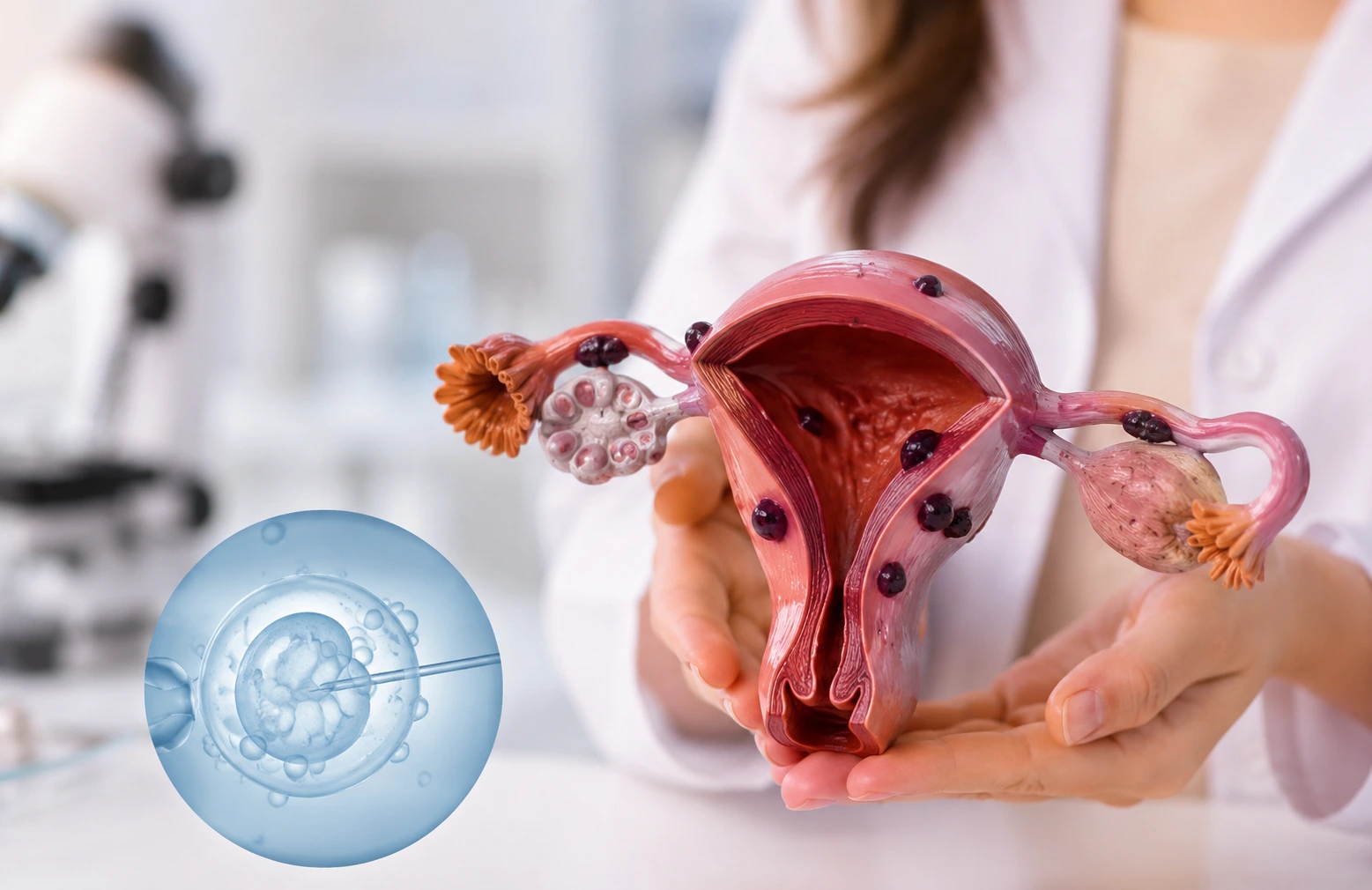
What current research actually says about endometriosis and IVF outcomes — and where the real impact shows up.
Quick takeaways
If you've been told you have endometriosis and you're now facing IVF, it's natural to wonder how much the diagnosis actually changes your odds. The honest answer, based on current evidence, is more reassuring than most people expect — but it does change where the impact shows up and how a protocol gets built around it.
Endometriosis affects roughly 10% of women of reproductive age, but that number climbs to as high as 50% among women being evaluated for infertility. It's a hormone-driven condition — tissue similar to the uterine lining grows outside the uterus, fueled in part by estrogen, in much the same hormonal territory we cover in our piece on causes of high estrogen in women. That overlap is one reason endometriosis so often surfaces during a broader fertility workup rather than as a standalone diagnosis.
A 2023 meta-analysis spanning nearly 9,000 women with endometriosis and over 42,000 without found no significant difference in live birth rate, clinical pregnancy rate, or fertilization rate between the two groups. The one outcome that was significantly lower: implantation rate. In practical terms, that points squarely at the embryo transfer stage as where endometriosis tends to make the biggest difference — not at whether eggs fertilize, but at whether an embryo successfully takes hold afterward.
For years, the standard approach was months of GnRH agonist hormone suppression before starting IVF, on the theory that quieting the disease first would improve outcomes. Updated 2022 ESHRE guidelines now strongly recommend against this as a routine step, since current evidence doesn't show it improves live birth rates over other approaches. Surgery before IVF is also no longer a default — it's generally reserved for specific situations, like pain, rapidly growing endometriomas, or lesions blocking access during egg retrieval. That matters because endometrioma surgery can itself lower ovarian reserve, the same concern we discuss in our guide to low AMH symptoms — so it's not a step to take lightly or routinely.
For one specific group — patients with endometriosis and a history of repeated implantation failure — treating disease activity before or around the IVF cycle made a real difference in one study: cumulative live birth rates rose from 27.7% in untreated patients to 43.6–46.3% in those who received treatment first. At Maaeri, this is exactly the kind of finding that shapes how we sequence care for endometriosis patients with a difficult history, rather than treating every case the same way.
None of this works as a generic checklist — it depends on disease severity, prior implantation history, and ovarian reserve, which is why a thorough diagnostic workup matters as much here as it does for any other fertility test in women. Endometriosis with infertility is common, and increasingly well understood — which means your protocol can be built around your actual situation, not a worst-case assumption.
This article is for general information only and isn't a substitute for personalized medical advice. Please consult a qualified fertility specialist to discuss your specific diagnosis and treatment options.


