
- 🕒 Mon - Sat 9AM - 6PM
- 📞 Phone : +91 98186 44599

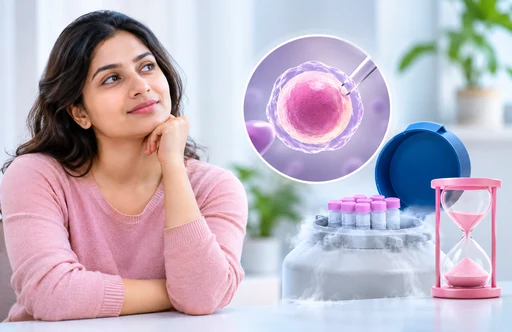
Egg freezing cost in India has come down a lot over the past decade as vitrification became standard, but it's still a big investment, and the moving parts aren't always explained clearly at the start. At Maaeri, we think a good decision starts with an honest breakdown: what egg freezing costs, what it gives you at different ages, and what to realistically expect before your first appointment.
For one round of stimulation and retrieval, egg freezing cost in India usually runs from ₹80,000 to ₹1,50,000, depending on the city, the clinic's lab and the protocol. That figure normally covers monitoring scans, the retrieval under sedation, the embryologist's fees and the first round of vitrification.
Stimulation medicines, the gonadotropin injections for 10 to 12 days, which usually cost ₹25,000 to ₹60,000 depending on the protocol and dose
GnRH antagonist, used to stop early ovulation, at ₹5,000 to ₹10,000
Annual storage, since frozen eggs sit in liquid nitrogen, at around ₹8,000 to ₹15,000 a year
The future thaw and ICSI cycle, which costs another ₹60,000 to ₹1,00,000 when you come to use the eggs
Always ask for a fully itemised quote before you commit. The headline number rarely tells the whole story.
What matters most is how old you are when the eggs are frozen, not when they're used. Frozen eggs don't age in storage, so eggs frozen at 32 behave like 32-year-old eggs whenever you use them, even if you're 40 by then.
The HFEA's guide to egg freezing is a useful independent read on this. As a rough guide, the picture looks something like this:
These are rough population estimates. Your own result depends on your ovarian reserve (AMH and antral follicle count), how you respond to stimulation and how good the lab's freezing is.
The number usually quoted is 15 to 20 mature (MII) eggs for women under 36 to give a reasonable overall chance of a baby. Modelling studies have estimated that around 10 eggs frozen at 36 or younger give a predicted live birth chance somewhere around 60 to 70%. Many women get there in one retrieval, and others need two.
Not every egg survives thawing. Survival is high in experienced labs, but not every surviving egg fertilises, and not every fertilised egg becomes a blastocyst you can transfer. You can read more about our egg freezing centre in Noida.
We suggest talking about egg freezing if you're:
Aged 28 to 38 and not ready to try for a baby yet, but want to keep your biological options open
About to have chemotherapy or pelvic radiotherapy
Diagnosed with early diminished ovarian reserve, where your reserve is falling faster than usual
From a family with a history of early menopause
The benefit drops a lot after 38. That's not because freezing stops working, it's because you get fewer, poorer eggs per cycle, so reaching the target number gets harder and more expensive. Our guide to the best age for egg freezing goes into this.
Does egg freezing affect natural fertility later?
No. The eggs collected are ones your body would have lost that month anyway, so the process doesn't eat into your remaining reserve in any meaningful way.
Is there a right number of cycles to do?
It depends on your age, AMH, antral follicle count and how you respond the first time. Many women under 35 build a good bank in one cycle. We usually look again after the first retrieval, based on how many mature eggs we got, before suggesting a second.
How long can frozen eggs be stored in India?
Current ICMR guidelines allow storage for up to 10 years, with extensions possible on medical grounds. Properly stored eggs don't deteriorate while frozen.
Understanding the full egg freezing cost in India, storage and future use included, lets you plan financially for a decision that's as much about logistics as medicine. At Maaeri, we go through every cost at the first consultation so nothing catches you out.
This article is for general educational purposes and is not a substitute for personalised medical advice from your fertility specialist or embryologist.


