
- 🕒 Mon - Sat 9AM - 6PM
- 📞 Phone : +91 98186 44599

By Dr. Ram Prakash, Maaeri Fertility & IVF Centre. Updated 14 October 2026.
Blastocyst vs day 3 transfer is not a question with one answer. Anyone who hands you one is describing their clinic's policy, not your embryos. The decision turns on how many embryos you have, because that is the variable deciding which option carries more risk. It is a more personal question than it looks.
What the embryo looks like at each stage
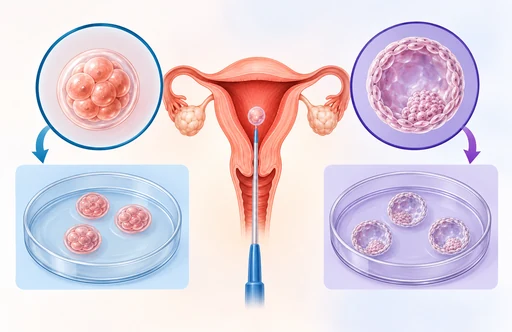
A day 3 embryo, called cleavage stage, has around 6 to 10 cells. By day 5 a blastocyst has 60 to 120 cells, with an inner cell mass and an outer trophectoderm that will become the placenta.
What extra culture buys you
Those two extra days are a filter. Embryos that stop dividing between day 3 and day 5 were unlikely to implant, so extended culture surfaces that in the laboratory rather than after a transfer. Blastocyst culture is how the embryology team does that selection.
The Cochrane figure, read properly
The 2022 Cochrane review pooled 32 randomised trials and 5,821 women. Here is what it found:
So a real advantage per transfer. A narrower one than the figures circulating online.
The part that is usually left out
Cochrane is uncertain whether blastocyst transfer improves the cumulative rate across a whole cycle. Read that again, because it is the sentence that gets dropped. Per transfer is not per cycle. If extended culture leaves you nothing to transfer, the higher per-transfer rate never applies to you.
|
What is established |
What it rests on |
|
Higher live birth per fresh transfer with blastocyst |
15 trials, 2,219 women, low-quality evidence |
|
Higher clinical pregnancy per fresh transfer |
32 trials, moderate-quality evidence |
|
Benefit across the whole cycle |
Uncertain on current evidence |
|
Vitrification may lift the cumulative rate |
A post-hoc analysis only, so not yet settled |
When it clearly makes sense
Where you have a good number of fertilised eggs, extended culture has room to work. It is also required for PGT, since the biopsy takes trophectoderm cells that only exist at blastocyst. A history of failed day 3 transfers is another reason to push on.
When day 3 may still be chosen
With few embryos the arithmetic changes. In patients with five or fewer zygotes, fresh day 3 transfer is still commonly performed, mainly to avoid cancelling the cycle outright. The ongoing PRECISE trial exists because the evidence in this subgroup is missing. Anyone calling it settled for small cohorts is ahead of the data.
Our post on what happens during embryo transfer walks through the day itself, whichever stage is chosen.
Why the two questions separated
Yes, and it is why the question has shifted at all. Once embryos can be vitrified reliably, the choice of transfer day stops being the same decision as the choice of transfer cycle. Those two used to be welded together. Fresh was the only option on the table.
How it works in practice here
Vitrifying blastocysts and transferring them later separates stimulation from implantation, letting the uterus recover and the timing be prepared properly. Frozen embryo transfer is now the usual plan here once there are good embryos to freeze, and it follows on naturally from egg retrieval.
Will my embryos definitely reach day 5?
Not all will. That is the trade-off, and it is the one your embryologist should discuss with you after the day 3 assessment rather than before the cycle starts.
Does waiting until day 5 harm embryos?
No. Culture conditions support development, and an embryo that arrests in the laboratory would most likely have arrested in the uterus. The HFEA page on IVF covers the surrounding steps.
Can a day 3 embryo be frozen?
It can. Blastocysts generally survive the thaw better, which is one more reason the freeze-all plan tends to pair with day 5.
On blastocyst vs day 3 transfer, the honest position is that blastocyst wins per transfer, the whole-cycle picture is unproven, and the size of your embryo cohort decides which of those two facts matters more to you.
This article is for general educational purposes and is not a substitute for personalised medical advice from your fertility specialist or embryologist


