
- 🕒 Mon - Sat 9AM - 6PM
- 📞 Phone : +91 98186 44599

By Dr. Ram Prakash, Maaeri Fertility & IVF Centre
AMH levels by age is among the most searched fertility terms there is, and it is among the most misread. Indeed we see this one number frighten patients far more than it should. Anti-Müllerian hormone is a genuinely useful measure of ovarian reserve, but the figure printed on your report does not tell you whether you can get pregnant, or how quickly, or what your chances are, and reading it as though it does is where most of the distress comes from. At Maaeri we read AMH the way it is meant to be read, alongside your age and your antral follicle count, never as one lonely number sitting there deciding your future.
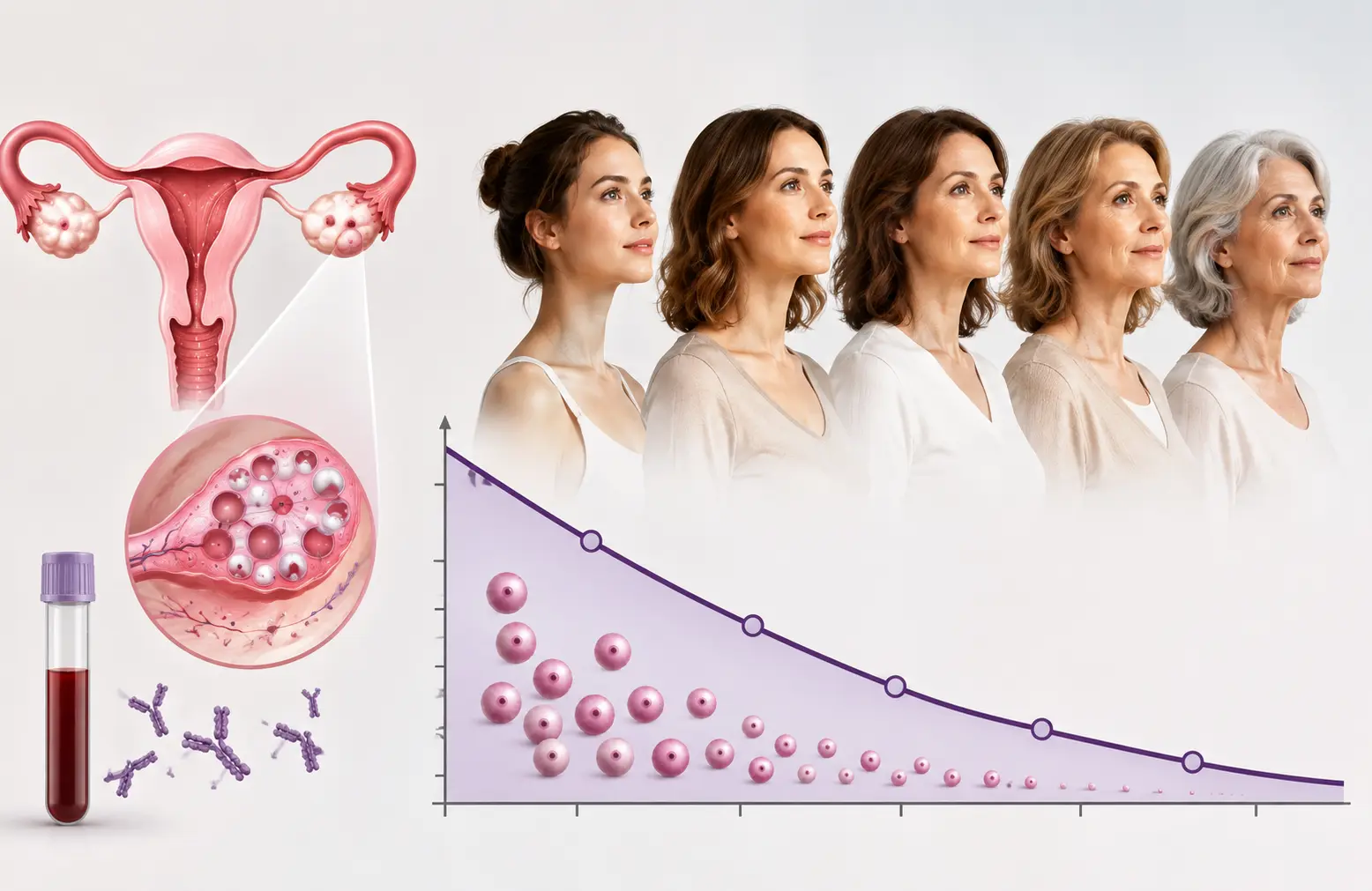
AMH is made by the granulosa cells of the small antral follicles in your ovaries. How much of it you produce tracks how many of those follicles you have, so the result gives an indirect measure of the pool remaining, which is what people mean by ovarian reserve. It has one practical advantage over the other reproductive hormones. AMH stays fairly stable across the menstrual cycle, so it can be drawn on any day, with none of the timing rules that govern FSH and oestradiol.
What AMH tells you: how many eggs you are likely to have remaining. What it does not tell you: the quality of those eggs, whether you can get pregnant naturally, or how quickly.
AMH falls as the years pass, that is simply what the pool does. Reference ranges do vary from one laboratory to another, and the broad shape holds:
|
Age Group |
AMH Range (ng/mL) |
What It Suggests |
|
Under 25 |
3.0 – 6.8 |
High ovarian reserve — typical for age |
|
25–30 |
2.5 – 5.0 |
Good reserve |
|
30–35 |
1.5 – 4.0 |
Normal, beginning gradual decline |
|
35–40 |
1.0 – 2.5 |
Moderate reserve — below-average for younger patients |
|
40–44 |
0.5 – 1.5 |
Lower reserve — IVF protocols typically adjusted |
|
Over 44 |
< 0.5 |
Low reserve; success rates decline significantly |
Having said that, there is no single cutoff everybody agrees on, it depends on your age and it depends on the assay, and the ranges above are approximate for that reason. Read your result against the intervals of the laboratory that produced it. A cutoff borrowed from some other system is how women end up frightened by a number that was never abnormal for them.
It means the pool remaining is smaller than is typical for your age, and that is really all it predicts. In IVF it has one concrete consequence, fewer eggs out per stimulation cycle. Beyond that it is made to mean a great deal it does not mean:
In any case we never read this number by itself here. It goes with the antral follicle count from the ultrasound, because between them they describe something neither one describes alone.
Above 4-5 ng/mL points to a larger pool than average and a higher egg yield to expect from IVF. Additionally, past 6-7 ng/mL the associations shift, toward PCOS and toward raised OHSS risk. A high result sends our team back over the stimulation dosing before the cycle starts, which is the only useful time to be looking at it.
Can AMH levels be improved?
No, and we say this plainly so nobody spends money expecting otherwise. AMH reports a follicle pool that already exists and nothing reliably raises it. DHEA and CoQ10 have been studied, though what those studies asked about was egg quality in poor responders. A different question altogether.
At what AMH level should I see a fertility specialist?
Under 35 and below 1.0 ng/mL, or over 35 and below 1.5 ng/mL while actively trying, is a fair point at which to ask for the full assessment.
Does AMH predict menopause timing?
It may hint at menopause arriving earlier where the level is low for the age. It is not a precise instrument though, and it is not on its own a reason to make an urgent decision about when to have children.
So treat AMH levels by age as a starting point and not a verdict, one number in isolation rarely tells anybody much. What gives it meaning is everything around it, your age, your cycle, your other results, and what you are actually trying to do.
This article is for general educational purposes and is not a substitute for personalised medical advice from your fertility specialist or embryologist


